Rhododendron and the empire | Inside ‘Paper Gardens’, a book and an exhibition at MAP
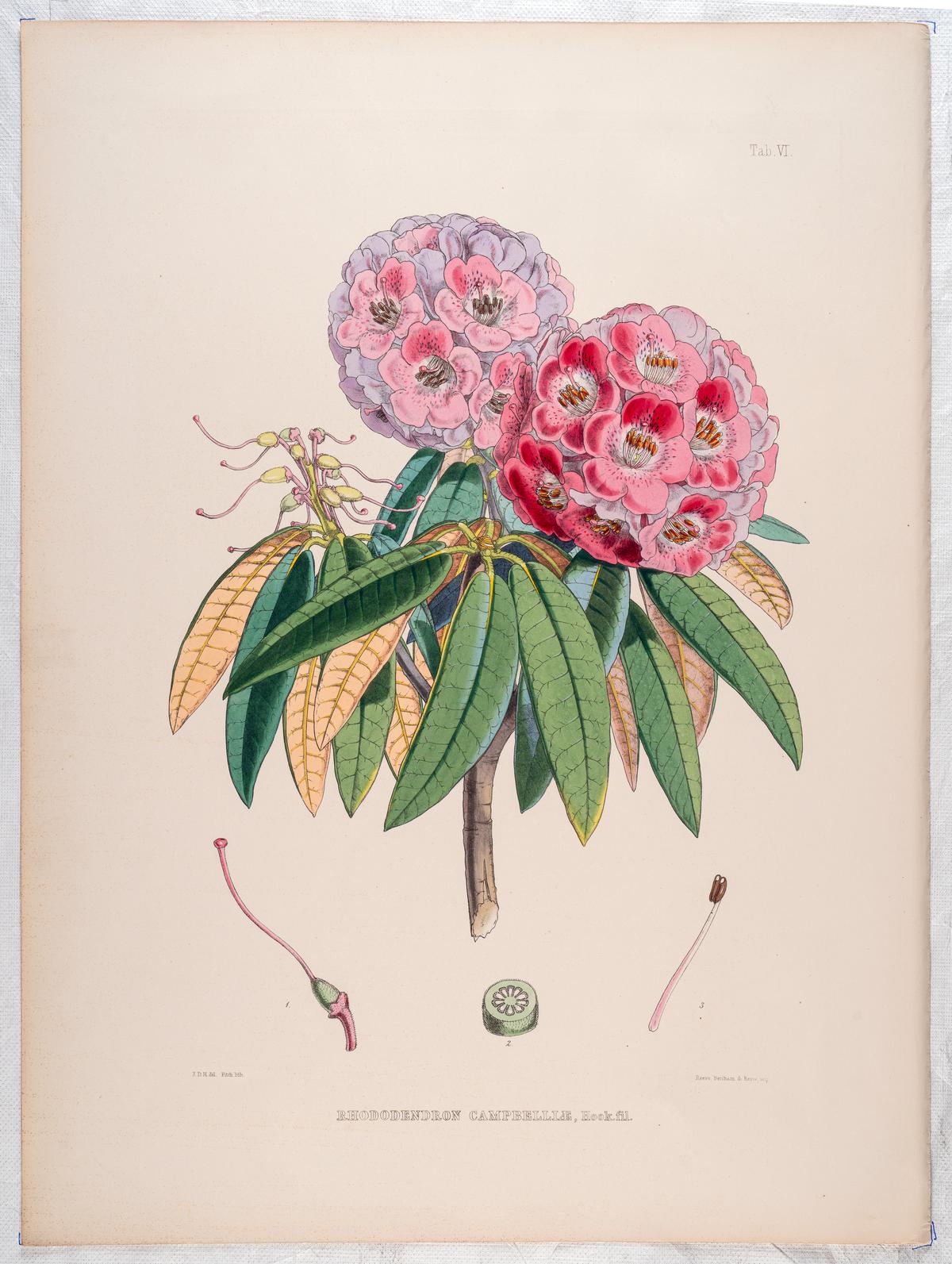
Every spring, rhododendrons paint the Himalayas and parts of the Northeast in vibrant reds, whites, purples and pinks. For writer and poet Sumana Roy, the elusive flower, which can still be seen at higher altitudes in June, is special. As she writes in ‘Wild Encounters: Searching for Rhododendrons’, her essay in the new book Paper Gardens: The Lives of Botanical Illustrations in India, while colonisers were drawn to the flowers for their sensual beauty, “the local will bite and chew the arrogance of the flowers”.

Rhododendron campbelliae (The Rhododendrons of Sikkim-Himalaya); author and artist: Joseph Dalton Hooker; lithographer: Walter Hood Fitch, 1849
| Photo Credit:
Courtesy MAP
Roy remembers her favourite rhododendron chutney, and even offers a recipe: “Crushing about five or six fresh red rhododendrons into a paste with a clove of garlic, a tomato, and its sweet-sour balance refined by the addition of molasses and dried mango powder. As I look at [British botanist Joseph Dalton] Hooker’s The Rhododendrons of Sikkim-Himalaya, this is what I miss — the flower inside my mouth.” Hooker’s 1849 book listed 33 species, but Roy says lived experience imbues the flowers with far more colour than is possible in the pages of a book.

A copy of Paper Gardens: The Lives of Botanical Illustrations in India
| Photo Credit:
Courtesy MAP

Illustrations from the book
| Photo Credit:
Courtesy MAP
Hooker’s rhododendron lithographs, meanwhile, feature in Paper Gardens: Art, Botany and Empire, the companion exhibition with over 120 works curated by Impart (formerly MAP Academy) at Bengaluru’s Museum of Art & Photography. The show has botanical artwork sourced from the collections of the U.K.’s Linnean Society and Wellcome Collection, and the U.S.’s Oak Spring Garden and the Missouri Botanical Garden — illustrating a time when, “between the 18th and 19th centuries, the Indian subcontinent was a site of intense scientific activity”, says Shrey Maurya, research director of Impart and curator of the show. “The exhibition emerged from a desire to bring these complex histories of botany, colonial expansion, artistic labour, and the global circulation of plant knowledge to the public.”
Paper Gardens: Art, Botany and Empire
| Video Credit:
Ravichandran N.
Colonial expansion and artistic labour
The exhibition is also an ode to Indian artists whose contribution to botanical taxonomy has been long ignored. “Around 27 works carry attributions to named artists, including Vishnuprasad, Gorachand, Govindoo, Rungiah, Haludar and K. Cheluviah Raju,” says Maurya. “There are also drawings and lithographs made by Indian artists for the Annals of the Calcutta Botanical Garden.”

Amherstia nobilis in Plantae Asiaticae Rariores (Descriptions and Figures of a Select Number of Unpublished East Indian Plants, Volume 1); author: Nathaniel Wallich; artist: Vishnupersaud; lithographer: Maxim Gauci, 1830
| Photo Credit:
Courtesy MAP

Leicesteria formosa in Plantae Asiaticae Rariores, Volume 2; author: Nathaniel Wallich; artist: Gorachand; lithographer: Maxim Gauci, 1831
| Photo Credit:
Courtesy MAP

“Relying on local collectors and gatherers, colonial botanists amassed an extraordinary archive. We meet the plants in the first two stages, documentation and classification [the third stage being instrumental appropriation], the new names coming as they usually did from the name of the ‘discoverer’ or their patron. But it took away two important moments: the record of the human’s first sightings of wonder on seeing the plant; and its culinary and medicinal use.”Sumana RoyAuthor

Averrhoa carambola; From a series of watercolours made at the Government School of Art, Calcutta, in the late 19th century; watercolour on paper
| Photo Credit:
Courtesy MAP

Garcinia mangostana (Mangosteen); Curtis’s Botanical Magazine, Vol. 81; editor: William Jackson Hooker; artist and lithographer: Walter Hood Fitch, 1855
| Photo Credit:
Courtesy MAP
Two volumes of Icones Plantarum Indiae Orientalis (Figures of Indian Plants), which contain around 600 illustrations primarily by artists Govindoo and Rungiah, are on exhibit, too, sourced from MAP’s collection, as well as reproductions from the Linnean Society.
Stories from Yale
Simultaneously, in the U.S., the exhibition Painters, Ports, and Profits: Artists and the East India Company, 1750-1850 tells the story of Indian, British, and Chinese artists whose works were commissioned by the East India Company to support its commercial and imperial goals. The exhibition, of over 100 objects, is mostly drawn from the Yale Center for British Art’s collection of works from Asia, including opaque watercolours, large oil portraits, architectural drafts, and a spectacular 37-foot-long scroll, Lucknow from the Gomti. There are scenographies, botanical specimens and fauna too, such as a detailed drawing of a rhinoceros by artist Gangaram Chintaman Navgire Tambat, from the Maratha Peshwa’s menagerie in Pune (1790).
Painters, Ports, and Profits is on till June 21 at the YCBA.

Skeleton Mantis & Oil Plant of Guzerat; Illustrations to Oriental Memoirs; author: James Forbes; artist: William Hooker, 1835
| Photo Credit:
Courtesy MAP
The book includes essays by experts such as American art historian Holly Shaffer and Scottish botanist Henry Noltie. It has “over a hundred images, and it traces encounters between plants, artists, and institutions — reanimating the networks of labour and imagination that have built our understanding of the natural world,” concludes Maurya.
The freelance writer is based in Chennai.
Published – June 09, 2026 12:16 pm IST