‘Fighter Didi’, ‘Chakri Koi’: Political parties take to memes, reels and videos for voter outreach in Bengal | Kolkata News
Barely a few days left for the Assembly elections, political parties in West Bengal are increasingly turning to social media to shape public opinion and voter mood, with platforms like YouTube and Instagram emerging as crucial arenas where narratives are constructed not just through policy pledges but also through emotion, symbolism and targeted messaging.
As part of its digital campaign, the Trinamool Congress (TMC) shared a YouTube video setting the tone with the lines: “Eilish ab gairkanuni hain” (Hilsa is now illegal), “Food that is not our tradition is a crime,” and “They are banning fish today, tomorrow mishti, and then even our language.”
Titled “Bengal e BJP ashle ki hobe?” (What will happen if BJP comes to power in Bengal?), the video unfolds through a fictional, cautionary narrative. It imagines a future where key aspects of Bengali identity, food, language and cultural practices are shown to be under threat. Through dramatised scenes, it shows a growing sense of unease, with the central character representing the ordinary voter who gradually appears to regret his political choice. The video relies on symbolism, using culturally significant elements like hilsa and mishti to evoke a deeper emotional response while portraying the prime minister’s image in a “villainised” manner. In doing so, it subtly warns of potential disruption to the social and cultural fabric of the state, particularly under the Bharatiya Janata Party (BJP).
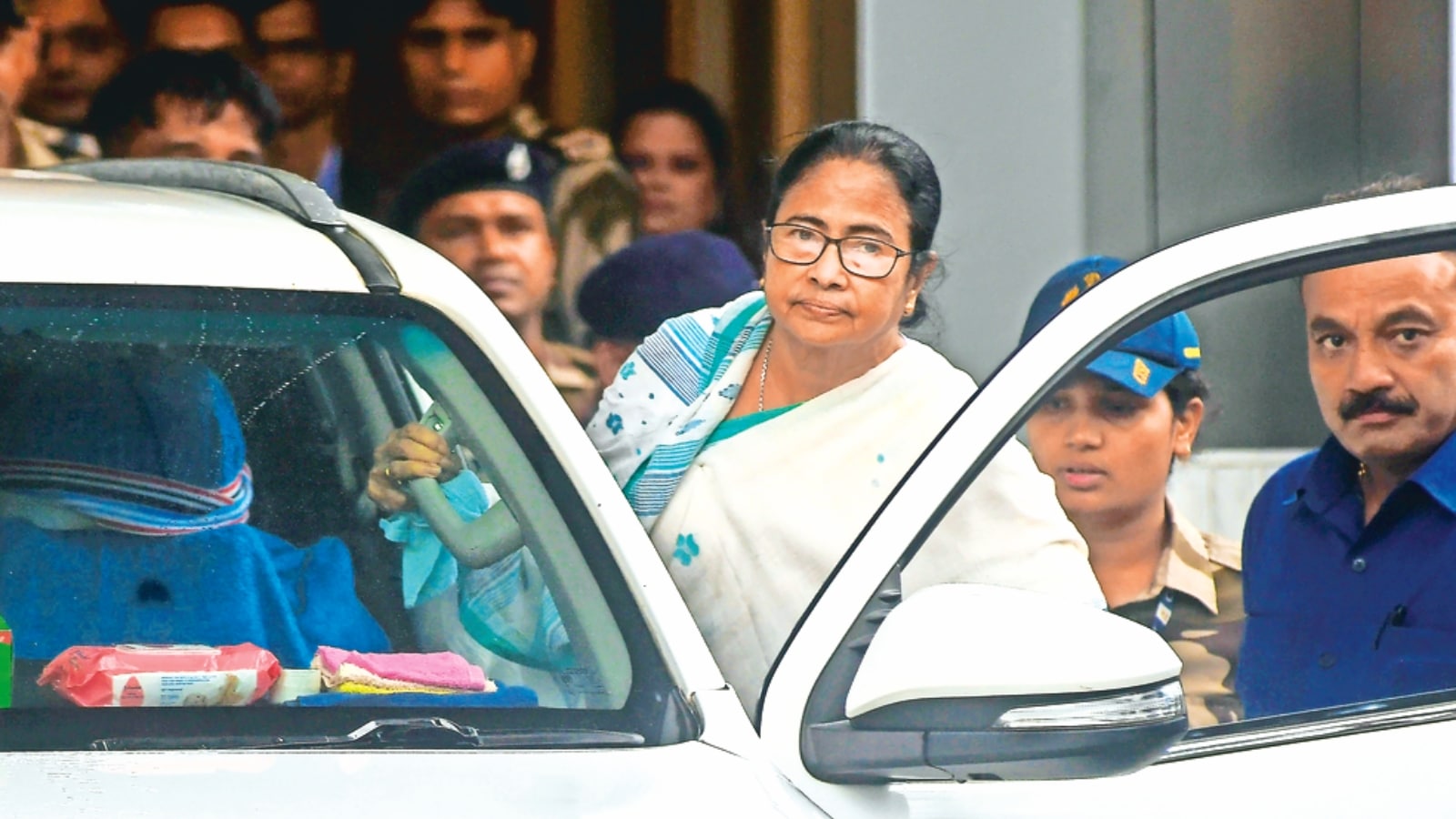
Building on this atmosphere of cultural anxiety, the TMC’s “Fighter Didi” campaign takes the narrative from cautionary to combative. In an AI-animated sequence, the TMC portrays the state’s welfare schemes like Lakshmir Bhandar, Rupashree and Kanyashree not just as policy achievements but as the symbolic armour of the Bengali woman.
The video casts Opposition leaders as menacing figures trying to snatch away the financial independence of women. More than just an advertisement, it takes the form of a digital folklore where the “Fighter” persona of CM Mamata Banerjee is mythologised. By concluding with “true event” footage of real world confrontations, the campaign seeks to ground its animated narrative in reality, sending a strong emotional message to voters that the welfare benefits are under threat and only a “fighter” can safeguard them.
This messaging is not just limited to long-form video content. On Instagram, leaders like Derek O’Brien are using humour and wordplay to reach out to younger audiences. Memes that turn political acronyms into food-related puns, such as equating “Bha Ja Pa” with “fried legs,” with captions reading “It might mean something significant in Hindi, but in Bangla it means fried legs,” ending with the line: “Never vote for fried legs.”
Story continues below this ad
Across YouTube and OTT platforms, advertisements highlight welfare schemes and state support, including one where an elderly man says, “Akhon pension pawa onek sohoj hoe gache” (Getting a pension has become much easier these days), reinforcing the party’s development narrative.
Parallelly, short Instagram videos featuring Mamata Banerjee adopt a more direct tone where she warns that the BJP could introduce NRC and detention camps in the state, while asserting resistance with the slogan “Korbo, Lorbo, Jitbo” (We will fight, we will act, we will win). Another recurring slogan “Jotoi koro hamla, Abar jitbe Bangla” (no matter how much you attack, Bengal will win again) reinforces this stance, with the party promoting a narrative of “protector of Bengali culture”, while portraying political change as a potential threat to both livelihood and identity.
Meanwhile, BJP’s official instagram page, BJP4BENGAL has adopted a reels-heavy strategy centred around animations, real life campaign snippets, short clips accompanied by slogans, emotional notes, crowd centric visuals and strong leadership centred on Prime Minister Narendra Modi.
A particular reel, with thousands of views, portrayed a livid metaphor for the consequences of voting for the incumbent government. It depicts a woman in a traditional white-and-red saree morphing into a burkha-clad figure, a farmer losing his produce, and a young man forced to leave the state for employment. Through such visuals, BJP appears to construct a fear-based narrative, suggesting threat to identity, property and future prospects under the current TMC dispensation, with BJP emerging as an alternative and safe choice, with hashtag #PaltanoDorkarChaiBJPSarkar.
Story continues below this ad
Women’s safety has emerged as a particularly dominant theme. Several posts reference the RG Kar Medical College incident, using it to highlight concerns over law and order. An example is the projection of Ratna Debnath, mother of the RG Kar victim and BJP’s candidate from Panihati. In reels captioned “When a mother’s grief becomes power”, she is shown engaging directly with voters, particularly women, during door-to-door outreach, with hashtags #BachteChaiBJPTai and #BJP4NariSurokkha (BJP for women’s safety).
Through a series of targeted video advertisements, the party has also foregrounded themes of alleged corruption and fear under the TMC rule, along with the recurring voice of a youth “Chakri koi?” (Where are the jobs?), echoing the laments of the unemployed youth, and short clips promising pension security for government employees and promise for women’s safety.
Addressing a public meeting, senior TMC leader Saayoni Ghosh adopted a culturally resonant style to question the BJP’s electoral promises.
Drawing from popular Hindi song lyrics, she said that before elections the BJP approaches voters with assurances like “Wada karo nahi chhodoge tum mera saath, jahan tum ho wahan main bhi hoon,” (promise me you will not abandon me, wherever you are, I will be there too). However, she contrasted this with post-election disillusionment invoking the line “Kya hua tera wada, wo kasam, wo iraada,” (what happened to your promise, your oath, your intent), suggesting that such commitments often remain unfulfilled.
Story continues below this ad
She further described this as “Jumla-baazi ki raajneeti,” (Politics of empty rhetoric), alleging that grand promises are made primarily for electoral gain. Using another metaphor, Ghosh added that voters are handed a “lollipop” before elections symbolising attractive but superficial assurances only to be left with a “neem ki kaathi” (a bitter stick) once the elections are over.
The CPI(M), meanwhile, has re-emerged with renewed energy aiming to connect with young voters and supporters of the party.
The official Facebook page CPIM West Bengal recently dropped a rap-style music video that has gone viral. Launching a fierce attack on the ruling TMC and the Opposition BJP, the party used the catchy tagline “Dui phool kei charte hobe” (Both flowers must be discarded), the party urged voters to reject the “Lotus” and the “Twin Flowers”.
“Vote din bachte, tara haturi kaste, ebar vote e bujhiye debo lal potakar dhok” (Vote for the hammer and sickle to survive; this election, we will show the power of the red flag), signalling the resurgence of Left Front in Bengal.
Story continues below this ad
The rallying cry of the visuals “Tumi ami Bangla bachai” (You and I will save Bengal) seeks to position the party as an alternative force in Bengal.
(Avantika Basu and Jigisha Seal work as interns with The Indian Express, Kolkata)