‘We protested about everything… didn’t need applications or approvals’: How protest culture is changing at DU | Delhi News

Once a space that saw charged student protests, especially during prominent periods in India’s political history — from the Emergency to the anti-CAA agitation — the space to dissent at Delhi University has undergone a sea change in the past few years, with student protesters often running into a wall of curbs and crackdowns. In February, the question of campus dissent was back in focus after DU announced a “blanket ban” on student gatherings followed by a fresh notification last week tightening rules for protests.
Even as the Delhi High Court flagged concerns over the legality of such restrictions, the university cited safety concerns and pointed to how recent protests have turned volatile.

The immediate trigger for these restrictions was an incident last month involving YouTuber Ruchi Tiwari, who was allegedly manhandled during a campus protest, against UGC rules on caste discrimination, that turned violent.
But for many who have spent decades in the university, the notification isn’t just a response to a single incident but a shift in the very character of the campus.
‘Protests were a part of academic life’
Historian Uma Chakravarti, who spent over three decades teaching at Miranda House, says protests were not an interruption to academic life but woven into it. “Miranda House was built with a reputation of nurturing initiative as far as protests were concerned,” she says. “We had politicised students, but also politicised teachers.”
One of the college’s early teachers was a socialist who contested elections against the Congress in the 1950s and was closely associated with Ram Manohar Lohia. “So, the college was never a space closed to political thinking. Teachers themselves were often political,” she adds.
That culture filtered into everyday campus life. Students questioned authority, traditions, and even aesthetics. The ‘Miss Miranda’ contest was eventually dismantled after sustained protests.
Story continues below this ad
“Early feminist expressions were very lively and powerful,” Chakravarti says.
During the Emergency, when dissent across the country was brutally stifled, students at Miranda House openly questioned then Prime Minister Indira Gandhi when she came to the campus as a guest for Founder’s Day.
Chakravarti recalls how one young student, in another instance, stood before Gandhi and tore up their degree. “What’s the use of this degree? I won’t get a job,” she recalls the student saying. “We protested about everything — gender, institutional functioning, national issues… There were no applications, no approvals. Nobody said, ‘You can’t do this.’ That language didn’t exist,” says the historian.
Anyone can start a protest and put it on social media… If something happens, who will take responsibility?”: Manoj Kumar Singh, Proctor, Delhi University
On February 17, after the clash during the UGC protest, the university prohibited all forms of gatherings for a month, followed by the imposition of prohibitory orders under BNSS Section 163 by the Delhi Police across North Campus. While that order was still in force, the police issued another notification in February barring “unrestricted” assembly with effect from February 25 until April 25.
Story continues below this ad
“Then on March 23, DU introduced a new structure for protests: organisers must now submit a signed, physical application at least 72 hours in advance, detailing names, affiliations, expected turnout, duration, logistics, and even the list of speakers. Social media posts or informal announcements will not count as permission. Outsiders are barred, and violations could invite rustication, expulsion, or police action.
Hearing a petition challenging curbs on protests, the HC, earlier on March 12, questioned the sweeping nature of the restrictions. Chief Justice D K Upadhyaya observed, “There are some pre-conditions that have to be met before passing any order under BNSS Section 163… Not only ‘apprehension’… if you’ve to prevent something which is going to happen tomorrow, only then can you use order under (BNSS Section 163). We are clearly of the opinion that there cannot be a blanket ban… We are also very doubtful if CrPC Section 144 (BNSS Section 163 equivalent) can be used.”
At the same time, the court had cautioned students, noting, “This liberty cannot be misused, can you deny this fact?… You have to conduct yourself appropriately… See what happened during the (DUSU) elections… we have to balance the situation…”
Professor Arun Prabha Mukherjee, a former English literature faculty member, echoes Chakravarti when she recalls earlier protests. In 1967, when she arrived at DU from Tikamgarh, a small town in Madhya Pradesh, to teach at Daulat Ram College, she found herself in a world alive with argument. “It was a lively hub of political activity,” she says. “There were student groups from every ideology — Communists, Congress, ABVP, all organising discussions and protests.”
“… if you’ve to prevent something which is going to happen tomorrow, only then can you use order under (BNSS Section 163). We are clearly of the opinion that there cannot be a blanket ban… : D K Upadhyaya, Chief Justice, Delhi High Court
Story continues below this ad
But the real university, she says, existed outside formal structures.
“There used to be an open-air coffee house near the Arts Faculty. People would sit there for hours… teachers, students… talking about politics, the world. That was your education.”
Protests, too, reflected this culture of debate rather than confrontation. During a protest during the Hindi movement in the late 1960s, a protester stopped Mukherjee’s colleague, who was walking with her, and asked him to cover an English book he was carrying. “He responded saying, ‘The pants you are wearing are English too, why don’t you remove them’,” she recalls.
“There were ideological differences,” she says, “but it was civilised. There was no violence.”
Story continues below this ad
Today, she says, that sense of safety has eroded, not just physically, but intellectually. During a visit to India in 2025, she was advised against speaking informally to students about her work. “That I should feel afraid to speak… it’s heartbreaking,” she says. “This is not just about protests. This is about what a university is allowed to be.”
Latika Gupta, now a faculty member in the Department of Education, recalls how protest culture shaped her own political journey. As part of the first batch of the B.El.Ed programme in 1998, she and two others went on a fast-unto-death after being told their degree would not allow them to pursue further studies or secure jobs.
“We didn’t begin with a protest,” she says. “We wrote letters, met officials, and tried every formal route.” Some even approached then Prime Minister Atal Bihari Vajpayee during his public grievance meetings. “When nothing worked, we escalated.”
Even then, she says, there was no permission regime.
“We informed the administration and police, that was it,” she says.
Story continues below this ad
Protest was understood as communication, a democratic language through which students expressed dissatisfaction. That language had many forms, with posters and cartoons being tools of critique.
“We used street theatre a lot,” Gupta says. “There would be plays happening in the open… and people would just gather.”
“Over the years, hostel students marched over food quality. Groups rallied against curfews, eventually leading to movements like Pinjra Tod [where girls protested against hostel curfew timings]. We would sit in groups, discuss issues, and then decide to act.”
Those spaces have steadily disappeared, says Gupta. “Today, I see a different campus as a teacher… Students no longer gather in the same way. The informal discussions, the debates, that culture has thinned out.”
Story continues below this ad
A necessary step: DU
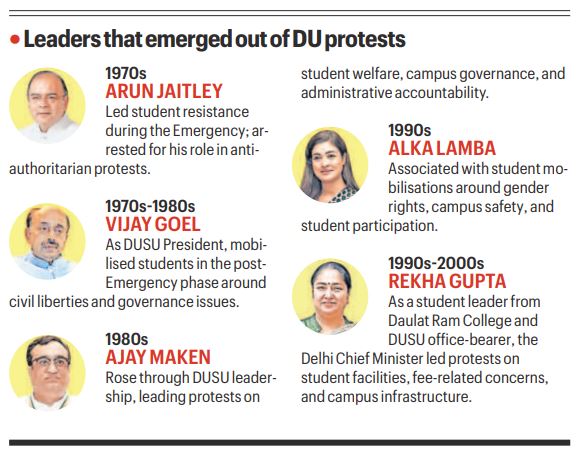
DU’s protest culture has always mirrored the country’s political churn as seen during the Emergency and the Mandal Commission protests. In 2019, protests against the Citizenship Amendment Act (CAA) saw students and teachers marching at North Campus and facing police action (see box).
Professor Harendra Nath Tiwari of Shri Ram College of Commerce says in his 25 years at Delhi University, he has never seen such a formal regulation. “If protest becomes dependent on permission, democracy itself will end.”
He says even earlier attempts at control during Vice-Chancellor Dinesh Singh’s tenure were informal, involving warnings and administrative pressure “But this is structural.”
The administration, however, views it as necessary.
Speaking to The Indian Express, Proctor Manoj Kumar Singh says, “Anyone can start a protest and put it on social media. If something happens, who will take responsibility?”
Story continues below this ad
He points to recent incidents, including the alleged assault on a YouTuber during a protest, to argue that spontaneous gatherings can turn unpredictable. “We are not stopping protests, we are just regularising them. It is for safety and smooth functioning.”
Registrar Vikas Gupta concurs. “Earlier, things were different. Now situations can become volatile.” Without prior coordination, he warns, protests could slip into disorder. “There is a difference between protest and gundagardi.”
When contacted by The Indian Express, Vice-Chancellor Yogesh Singh declined to comment, only saying that his responsibility was to “protect the interests of students and the university”.
Student speak
Among students, the response is divided. Rahul Jhansla, Vice-President of the Delhi University Students’ Union (DUSU) belonging to the Congress youth wing, the NSUI, sees the move as a direct attack on democratic rights and argues that the policy could be used to control mobilisation and limit ideological engagement.
“If something happens today, we will protest tomorrow. Why should we wait 72 hours? In that time, the issue will be suppressed,” he says.
DUSU Joint Secretary Deepika Jha, from the Akhil Bharatiya Vidyarthi Parishad, defends the decision. According to her, prior intimation allows for better security and avoids escalation.
“The university wants to prevent clashes. Students come from across the country to study at DU. It is important to maintain peace.”
Meanwhile, at the Arts Faculty, the stretch around the Swami Vivekananda statue, once a site of slogans and impromptu gatherings, now stands unusually quiet with students passing in and out of departments and the Central Library.
An 18-year-old first-year undergraduate student of Political Science (Hons) at Hindu College says he grew up hearing stories about DU’s student politics, fiery speeches, and late-night discussions.
“I thought this is where students question everything, where you see protests happening all the time. But I haven’t really seen anything like that,” he says.
“I actually wanted to join SFI when I came here. I was very interested. But now… I don’t know.” “You see what is happening. Students are getting picked up, taken into custody. Recently, some students went missing after protests and then we heard they were detained. If you are in your first year, you don’t know how things work yet. Why would you take that risk?” he adds.
Another 18-year-old first-year BA Programme student at Ramjas College voices a similar unease. She had attended one protest briefly during her first semester but left midway.
“My parents keep calling me and telling me not to get involved,” she says. “They see news about students being detained or clashes happening, and they get worried. Even here, seniors tell us to be careful.”
“People discuss things in private, in small groups, but not openly,” she adds. “There is always this feeling… what if something happens?”
***
Timeline of recent protests
2026
-University imposes one-month blanket ban on protests across campuses; Delhi Police enforces prohibitory orders.
-UGC regulation protest at Arts Faculty turns violent, leading to clashes, cross-FIRs, and controversy involving a YouTuber
2025
-Palestine solidarity march at DU turns violent after alleged clashes between student groups and police.
2023
-Students detained outside Hansraj College during a protest over a ban on non-veg food.
-Students penalised after BBC documentary screening protest controversy.
2022
DUTA-led protest dharna at Arts Faculty over university and policy issues.
2020
-Students and faculty detained during protests against online exam policies and administrative decisions
-Faculty protest over unpaid salaries
2019-2020
Large-scale protests against the Citizenship Amendment Act (CAA), DU becomes a major mobilisation site with marches, teach-ins, and police action.
2018
Delhi School of Journalism protests over infrastructure, fees, and faculty shortages; sustained student agitation.
2017
Ramjas College protests turn violent after disruption of a seminar, leading to campus-wide clashes and heavy police deployment.
2013-2014
Massive protests against the Four-Year Undergraduate Programme (FYUP) students and teachers mobilise until the programme is rolled back
***
Historic DU Protests
1975-77: Emergency-era resistance
- Students and teachers in Delhi University resisted censorship and arrests during the Emergency.
Late 1960s-1970s: Language & ideological protests
- Mobilisations around Hindi as medium of instruction and broader ideological debates across campuses.
1990: Mandal Commission protests
- DU campuses witnessed intense mobilisation during the Mandal Commission protests.The Mandal Commission recommended 27% reservation for OBCs in government jobs and education, triggering nationwide student protests and reshaping India’s politics of caste and representation
2011: Anna Hazare anti-corruption movement
- Large numbers of DU students participated in protests led by Anna Hazare, including mobilisations near North Campus and central Delhi.The Anna Hazare anti-corruption movement was a nationwide protest led by Anna Hazare demanding a strong anti-corruption law (Jan Lokpal), which saw massive student participation, including from Delhi University.