Sound Smart: 6 Observations from the NFL Annual League Meeting
PHOENIX — We all know Sean McVay’s memory is sticky, with the Los Angeles Rams coach demonstrating an archival and categorical knowledge of football during his weekly press conferences. But it doesn’t stop there.
At the Biltmore Hotel, site of the 2026 Annual NFL League Meeting, McVay and Eagles coach Nick Sirianni were talking about what Duke’s Cayden Boozer could’ve done differently in the team’s crushing loss to UConn. McVay wanted Boozer to hold the ball and take the foul in the final seconds, but the point guard instead tried to pass the ball and turned it over, leading to The Shot 2.0. Sirianni nodded along in approval, which led McVay to start referencing March Madness plays from last year.
Yes, this is still college hoops time, but you probably need your NFL fix.
That’s what I’ve got — six observations from my four days at the owners meeting in Arizona last week. This is “Sound Smart,” where I try to spin forward, dive deeper and think outside the box. If I do my job, you’ll have a better understanding of what’s happening this NFL offseason.
1. WHAT IF?
Chicago Bears coach Ben Johnson sets forth “the challenge” for Caleb Williams
There is no more obvious statistic for Bears quarterback Caleb Williams to improve than his completion percentage, which landed at 58.1% in 2025. Speaking to multiple Bears staffers at the owners meeting — including a one-on-one with coach Ben Johnson — there is clear optimism that Williams can improve that number sizably in his third NFL season.

Caleb Williams earned a reputation as a clutch quarterback in 2025, but his completion percentage actually dipped from his rookie season. (Photo by Todd Rosenberg/Getty Images)
That confidence comes from a self-scout that the Chicago coaching staff recently did. The coaches examined every play, and in the case of the passing plays, they saw opportunities for improvement. From that self-scout, Johnson is going to identify the top three items for Williams to focus on improving. And by now, you surely know one of the items on that list.
“We need to get the completion percentage up,” Johnson told me. “And so we’ll look at that as we go through the cut-ups of where we can best do that. There were probably 80 or 90 throws on tape that we felt like could have been completions.
“You’re always going to have some drops by the route-runners. … We need to find a way to complete some of those other ones, though. That’s really the challenge for Caleb. If we do that, then we’ll be 65%, 70% completion, which is closer to where we want to be.”
Another Bears source picked the high end of that range: 70%. It speaks to how bullish the Bears are on Williams that they think he can get that number up almost 12 percentage points this year.
In 2025, his completion percentage over expected was -6.9%, and his time to throw was a full 3.2 seconds, per Next Gen Stats. Those shortcomings are, in part, why his expected points per dropback landed at 14th in the NFL (.05).
Williams should be able to get the ball out more quickly by trusting the system — and his receivers, who do a good job getting open. What makes Williams so impressive — and has the Bears trusting him so immensely — isn’t just that he can make big plays. It’s that he took just 24 sacks last season (after taking a league-high 68 as a rookie) and threw just seven interceptions. He kept the team on schedule, which played a major role in the Bears sticking around in (and winning) close games last year.
A gulf stands between Williams’ 2025 season and his goal for the 2026 season. But given the way Williams improved from Year 1 to Year 2, in Year 3 the QB may just get the most out of his young core and achieve the high standard his coach is setting.
2. IF THERE’S ONE THING YOU SHOULD KNOW…
An 18-game schedule may not be what’s best for the NFL in the long term.
Adding one more game to the NFL schedule is much more complicated when measuring the value of the league’s product over the long haul instead of the clear short-term profit. It could be argued that the more games are added to the league’s schedule, the less importance each week has.
The beauty of the NFL schedule is how precious its games are. Since the NFL made the regular season 17 games in 2021, the quality of the game has been diluted. There are weeks when the stakes don’t feel high enough.
The NFL schedule is already 27 weeks long, starting with the Hall of Fame Game and ending with the Super Bowl. That’s already more than half the calendar year. The frequency is also increasing, as the NFL will have a game on every day of the week except Tuesday next season with the addition of a Wednesday game the day before Thanksgiving.
It was interesting to hear what Cowboys owner Jerry Jones thought about the issue — given how much he has grown the league’s brand since buying the team in 1989. He was asked if this might be a case of pigs getting fat and hogs getting slaughtered.
Jones countered with an animal-related pearl of wisdom of his own.
“When the duck quacks, feed it,” he said in Phoenix. “We have that demand for our games because of the hard work, great players that we have. … We should address it, respond to it and feed it.”
Feeding the beast has always worked for the NFL, but at what point is it overfeeding?
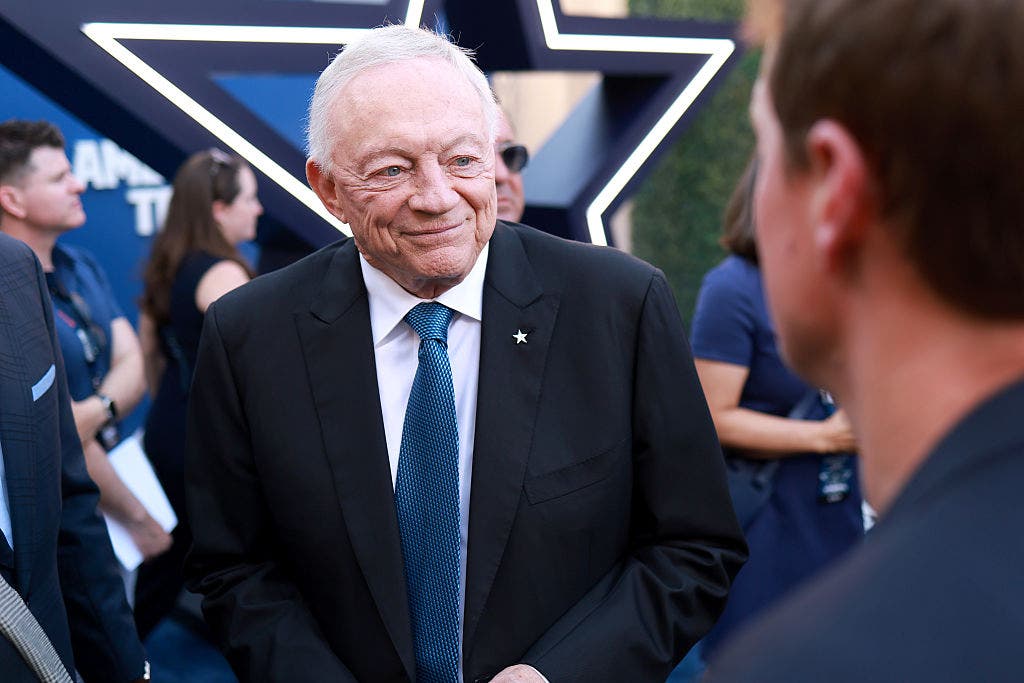
Cowboys owner and GM Jerry Jones has a unique perspective on adding to the NFL schedule. (Photo by Matt Winkelmeyer/Getty Images for Netflix)
3. BEHIND THE SCENES
Sights and sounds from the owners meeting
The league encourages the highest level of competition, which is why any time you put two coaches in a room or on a field, they view each other as adversaries. Even joint practices — an opportunity for a brotherly rivalry — is still an open competition by nature.
That’s what makes the owners meeting unique. It’s the friendliest NFL event of the year. Everyone is working — and often working together — but there’s time to play 18 holes, sit at the bar and chat and think aloud by the pool.
So here are a few unfiltered moments that I found fun from my time at the Biltmore Hotel.
- Chiefs coach Andy Reid could not be spotted in anything other than his standard-issue Hawaiian shirts.
- At the event’s party on Monday night, Lions coach Dan Campbell and Jets coach Aaron Glenn ended up at a high-top table together, where they spent over an hour catching up. Glenn, of course, used to be Campbell’s defensive coordinator in Detroit. The only one missing was Bears coach Ben Johnson, who was Campbell’s offensive coordinator.
- Catching up with a reporter, 62-year-old Broncos coach Sean Payton stood up to get into a two-point stance, as if he were a slot receiver — and explained what that player’s assignment should be pre-snap.
- Most often, a team’s leaders — coach and general manager — moved in packs. Jaguars coach Liam Coen and GM James Gladstone, for example, were often at each other’s side. So it was always fun to see GMs chatting on their way to and from meetings. Gladstone and Eagles GM Howie Roseman, for example, strolled through the lobby together. Colts GM Chris Ballard and Browns GM Andrew Berry were lost in conversation at one point during the event.
- At another point, a GM was chatting with a coach in the lobby. The GM concluded the conversation by saying he had to go meet with the Titans: “Got to go figure out who they’re taking at [No.] 4!?”
4. PEELING BACK THE CURTAIN
Here’s why DJ Moore was so important to the Bills and Joe Brady.
As new Bills coach Joe Brady worked to build a new identity for his team — a unique challenge, given how many of Sean McDermott’s staffers Brady will retain — the young coach looked to his past to find touchstone points for Buffalo’s culture.
Brady, for example, told me his “biggest hire” was Pete Carmichael, the Bills’ new offensive coordinator. Carmichael and Brady worked together under Sean Payton for two years in New Orleans. And the team’s biggest offseason move? That was Buffalo’s trade for receiver DJ Moore, whom Brady worked with during their days with the Carolina Panthers.
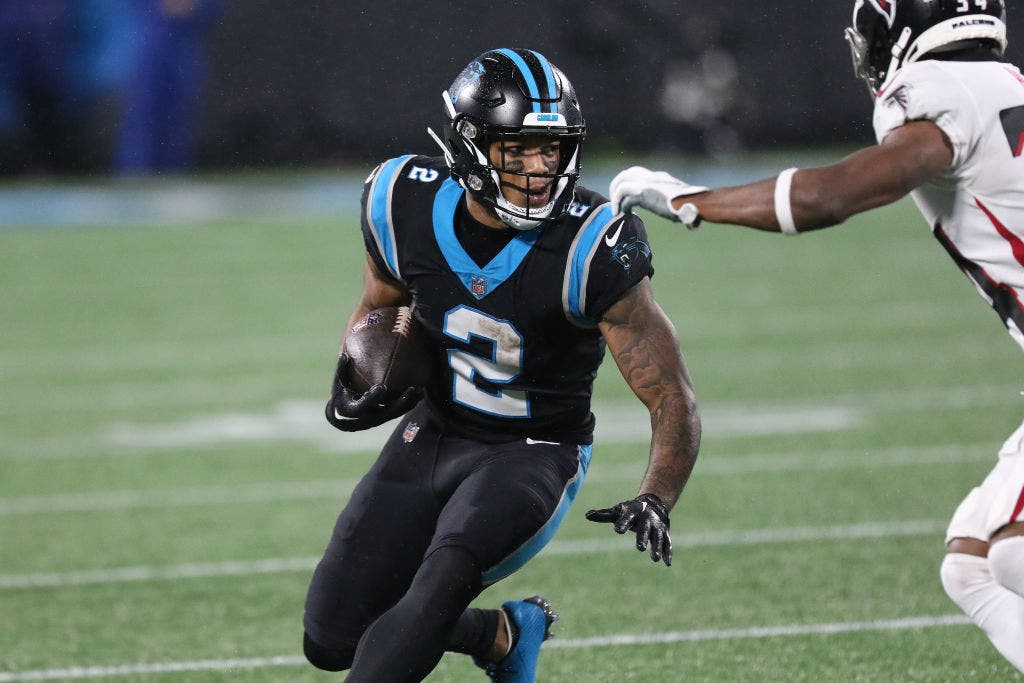
DJ Moore spent his first five NFL seasons in Carolina, where he had three 1,000-yard receiving seasons for the Panthers. (Photo by John Byrum/Icon Sportswire via Getty Images)
Interestingly enough, Brady once called that era of his career “my downfall.” But he decided to draw from that time, because of what he and Moore went through together.
“I wouldn’t be talking to you right now if I didn’t go through the Carolina days. I learned a lot from that,” Brady told me. “DJ was a guy, through the ups and downs in the Carolina days, who was consistent — his work ethic, his approach, his ability to go out there and make plays, being able to move him around.
“He has a skill set that I thought would be a great addition to us both in the locker room and on the field and, man, I’m excited to work with him again.”
That enthusiasm, in part, led Bills GM Brandon Beane to trade a second-round pick to Chicago for Moore and a fifth-rounder. Now, Moore is the WR1 that the Bills have so badly needed since Stefon Diggs’ departure. The goal isn’t just to build culture. It’s also to make star QB Josh Allen happy.
5. WHAT’S NEXT?
Mike Vrabel’s comments about TreVeyon Henderson on Jaden Ivey were a good start, but I hope they’re just that — the start.
New England Patriots running back TreVeyon Henderson tweeted a Bible verse that aligned himself with NBA player Jaden Ivey, whom the Chicago Bulls waived last week following anti-LGBTQ comments.
Ivey said that Pride Month is a celebration of “unrighteousness.” When news of Ivey’s release broke, Henderson responded on X with a Bible verse, Matthew 5:10.
“Blessed are those who are persecuted for righteousness’ sake, for theirs is the kingdom of heaven,” Henderson wrote.
The day after Henderson’s post, Patriots coach Mike Vrabel fielded a question about it at the league meeting.
“I think there is a fine line,” Vrabel said. “I want to tell you — I love TreVeyon. I love the person. He cares deeply about our team. He cares deeply about his faith. He cares deeply about his family, his wife, the people in our building. And so I want them to be able to express what they believe in their heart and in their mind, but also want to make sure that they’re educated. And we want to be inclusive. Everything we want to do [is] to provide an environment for people to want to feel comfortable, but also to share their personal beliefs. And then also, we represent the team. And we represent the organization.”
It’s a nice place to start.
I understand where Vrabel was coming from: Empathy and understanding might be the remedy to this situation. That’s Vrabel’s philosophy on how he coaches his players — by showing them love while also telling them the harsh truth.
6. OFFSEASON ODDITY
The Lions are considering moving Penei Sewell from right tackle to left, according to coach Dan Campbell.
You don’t often hear about an NFL team switching the position of its best player. That’s what Campbell is interested in doing with Sewell, whom the Lions might move from right tackle to left.
“If you’re asking me, I’d like to move him,” Campbell said at the owners meeting. “We are ready to do that, if need be. I don’t want to say right now I’m going to commit to that, but we are ready to do that.”
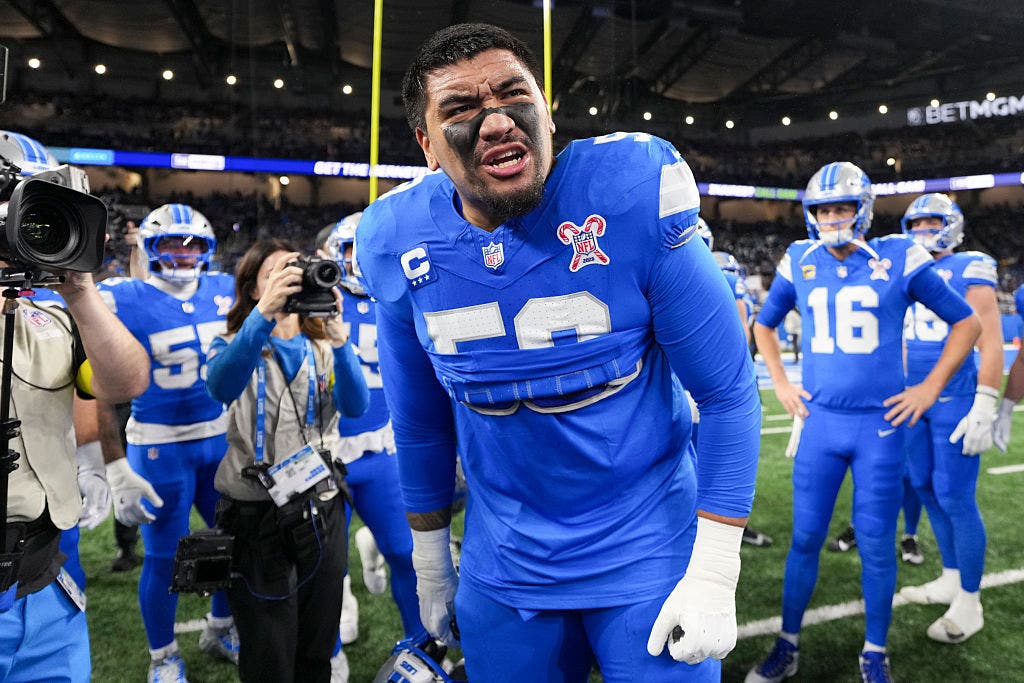
Penei Sewell is a three-time All-Pro as a right tackle. Does it make sense to move him to the other side of the line? (Photo by Todd Rosenberg/Getty Images)
It reminds me of when the Chiefs moved Trent McDuffie — another one of the league’s elite players — from the slot cornerback spot to the perimeter in 2024. The moves are comparable, with different techniques and duties — and a heightened sense of competition.
It went well for McDuffie. It should go just fine for Sewell, who played left tackle at Oregon before the Lions drafted him in 2021 and moved him to the right side.
“All he wants is a couple of days to work his left-handed stance a little bit,” Campbell said of Sewell. “It’s a little bit like riding a bike for him. He’ll be fine. He’ll bank some reps and be able to do it. He gives us that flexibility.”
There are inherent risks, of course. Sewell could hit unforeseen adversity in the transition, simply because the two positions are more different than people realize. Every offensive lineman will tell you that. And then the position change for Sewell would open up the right tackle spot for an open competition — likely involving a rookie. The Lions pick at No. 17 in the first round, and while it appears to be a tough draft to find a left tackle, there should be a handful of right tackles who go in Round 1.
We’ve seen teams have success with this type of move in the past. Buccaneers tackle Tristan Wirfs and Bengals tackle Orlando Brown made the move across the line to the blindside without a hitch. There’s basically no reason why Sewell won’t be dominant on the left. But the stakes will be extremely high — and there will be no margin for error. And if the Lions have a rookie at right tackle and Sewell at left, how long will it take for everyone to get acclimated?
Given Detroit’s inconsistencies on offense last year (and their decision to make changes at offensive coordinator), the move would be one of the most scrutinized personnel decisions of the offseason. The Lions can’t waste any time in arguably the NFL’s best division, the NFC North.