Remembering Batukeshwar Dutt, the forgotten comrade of Bhagat Singh
On April 8, 1929, the Hindustan Times in Delhi rushed out a special evening edition, while The Statesman in Calcutta cabled its story to London to evade colonial censorship. That afternoon, two young men had thrown harmless bombs into the Central Assembly Hall, now Parliament, raising slogans of Inquilab Zindabad (Long Live the Revolution) and Samrajyavad ka Nash Ho (Down with Imperialism). They scattered red pamphlets titled ‘To Make the Deaf Hear’. Reporters caught the words, and newspapers across India and abroad carried dramatic headlines. One international paper proclaimed: “Reds Storm the Assembly!”
The two young men were Bhagat Singh and Batukeshwar Dutt. Both were arrested, tried, and convicted. While Bhagat Singh went on to become one of the most iconic figures of the Indian freedom struggle, his comrade Dutt gradually faded from public memory, remembered only occasionally, and rarely honoured with the dignity he deserved.
A revolutionary’s journey
Batukeshwar Dutt was born on November 18, 1910, in the Burdwan district of Bengal. Convicted in the Delhi Assembly Bomb Case on June 12, 1929, he spent nine years in prisons across India — Multan, Jhelum, Trichinopoly, Salem, and even the Andamans. In each jail he resorted to hunger strikes, twice fasting for over a month, demanding humane treatment for political prisoners.
When Bhagat Singh, Rajguru, and Sukhdev were executed in Lahore on March 23, 1931, Dutt was languishing in the Salem jail. That night he dreamt of Singh in chains, a vision that haunted him. Released in 1938, Dutt was rearrested during the Quit India movement of 1942 and spent another four years in jail.
After his release, he married Anjali, a school teacher, and settled in Patna with their daughter Bharti, who later became a Professor of Economics at Patna College. But life after independence offered little stability. The Bihar government allotted him a coal depot, but it proved financially unviable. President Rajendra Prasad intervened, urging the State to extend due consideration to him. The gesture resulted only in a token nomination to the Bihar Legislative Council — for the remainder of an existing member’s six-month term.
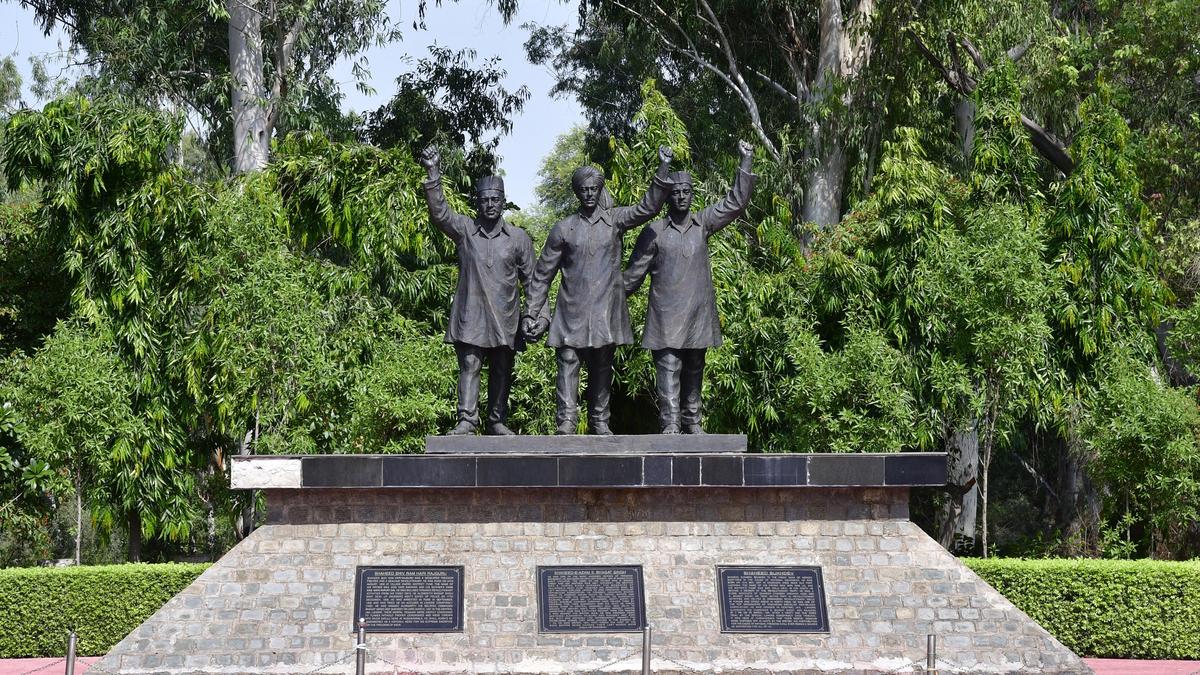
Despite such neglect, Dutt remained respected by many political leaders. His health, however, declined in the mid-1960s. Afflicted with bone cancer, he was admitted to AIIMS, New Delhi, where he endured eight months of suffering. Leading orthopaedist Dr. Vig told his comrades that treatment could only ensure a “painless death”. Plans to send him abroad were abandoned after the Indian High Commission in London reported that Delhi offered care equal to Europe’s. Dutt passed away on July 20, 1965. Honouring his last wish, he was cremated at Hussainiwala in Punjab, alongside Bhagat Singh, Rajguru, and Sukhdev. The site, which remained in Pakistan until 1965, had only recently come under Indian control for the construction of a memorial to the martyrs.
Neglect and recognition
For a brief moment after his death, the nation honoured Dutt. His funeral procession was massive, attended by the President, Prime Minister, central ministers, the Lok Sabha Speaker, and the Punjab Chief Minister. The funeral drew vast numbers of people along the streets. Yet today, few remember that the farewell accorded to him rivalled those of the most revered leaders of his time.
Ironically, the Parliament building where he and Bhagat Singh had staged their act of defiance still does not display their portraits. In contrast, the portrait of V. D. Savarkar, once an accused in Gandhi’s assassination case (though later acquitted), hangs prominently opposite Gandhi’s. In 2014, MPs including Dharamvira Gandhi and Sitaram Yechury protested this omission, but the demand to include Bhagat Singh — and by extension Dutt — was ignored.
The story of this neglect was first documented by Chaman Lal Azad, a fellow revolutionary who later became a journalist. While caring for Dutt at AIIMS, Chaman Lal Azad wrote a series of articles in the Urdu daily Pratap. These were later compiled as Bhagat Singh aur Dutt ki Amar Kahani (1966), one of the most authentic, if scattered, accounts of the revolutionary movement. The book contains Bhagat Singh’s letters, court statements, and postcards — some published for the first time — along with Gandhi’s letter to Dutt and rare photographs of him with Nehru and Indira Gandhi in 1963.
The book also records Dutt’s conversations about fellow revolutionaries. In it, he spoke of Hari Kishan Talwar, who was hanged in 1931 for shooting Punjab’s Lieutenant Governor, and of his comrade Ehsan Ilahi, who migrated to Pakistan, became a musician, and died penniless despite Chaman Lal Azad’s attempts to help him. Dutt also disapproved of films made on Bhagat Singh in the 1950s, which he and other comrades protested against. Only Manoj Kumar’s Shaheed in 1965 won their approval, with the actor personally consulting Dutt.
Equally touching are accounts of his bond with Bhagat Singh’s family. Mata Vidyawati, Bhagat Singh’s mother, spent long periods with Dutt in his final days. She even sold a Hindi epic poem on Bhagat Singh, gifted to her by poet Sri Krishan Saral, to raise funds for Dutt’s treatment. Revolutionary comrades such as Shiv Verma, Sadashiv Malkapurkar, and Jatin Das’s brother Kiran Das remained constantly by his side. Leaders including Home Minister Gulzari Lal Nanda, Defence Minister Y. B. Chavan, Jagjivan Ram, Swaran Singh, and Dr. Sushila Nayyar also visited him in hospital, though such respect was rarely extended while he was alive and struggling.
Ode to the forgotten soldier
Chaman Lal Azad used his book to underline Bhagat Singh’s intellectual legacy — his ability to rise above religion and envision socialism as the foundation of India’s future. Dutt himself remarked that Singh was far-sighted, always with a book in hand, reading wherever he went.
Despite having a shared vision of India’s future, history has not treated Dutt kindly. He remains absent from memorials, textbooks, and the national consciousness. While newer works such as Justice Anil Verma’s Bhagat Singh ke Sahyogi: Batukeshwar Dutt and Bhairav Lal Das’s Viplvi Batukeshwar Dutt (both post-2007) have attempted to reclaim his place, Chaman Lal Azad’s earlier book, rich with first-hand memories, is nearly lost. Its Hindi translation, commissioned years ago by the Government’s Publications Division, still lies unpublished due to copyright hurdles.
Dutt’s life illustrates how revolutionaries in India are often remembered only in passing.
Chaman Lal is a professor (retired) and a former chairperson of the Centre of Indian Languages at Jawaharlal Nehru University.