How Stanford rankings validate the ascent of Indian scientific influence
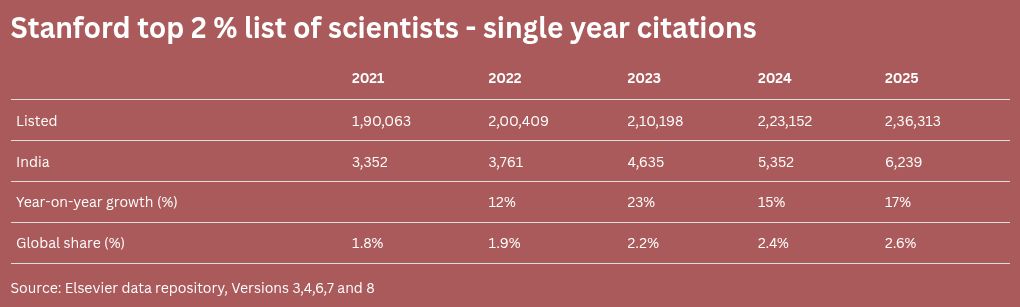
The recently published Stanford top 2% world scientists list for 2025 includes 6,239 Indian researchers, a significant increase of 17% over 5,352 in 2024, and an enhanced global share of 2.6% over 2.4% in 2024 and 2.2% in 2023. This article analyses the trends of global share of India in fields of impactful research and presents a broad roadmap for India to achieve technological sovereignty, which is critical to succeed in the current complex political-economic-social-technological landscape of the world.
Stanford list of top 2% world scientists
The objective of creating the Stanford global top 2% scientists list was primarily to provide a comprehensive and transparent measure of research impact, using the composite indicator (c-score), which considers multiple parameters, like total citations (both single-year and career-long citations), retractions, self-citations, the traditional h-index, and co-authorship, based on authorship position.
The list is built by a team of researchers at Stanford University, led by Professor John P.A. Ioannidis, using Elsevier’s Scopus database, considered to be the world’s largest indexed global citation database. Out of an estimated 109 lakh scientific authors in the world, the list for 2025 includes about 2.2% of the highly cited researchers during 2024, working out to some 2,36,313 scientists, who are classified into five domains: Applied Sciences, Arts and Humanities, Economic and Social Sciences, Health Sciences, and Natural Sciences, further segregated into 22 primary scientific fields and 174 sub-fields.
Share of India in the list of global influential scientists
While the number of listed scientists in the last five years increased, accounting for the increasing base of researchers in the world, India’s contribution reflects a steady rise in both the quantitative and the qualitative contribution of Indian scientists in impactful research
Quantity versus quality of publications: Impact gap
As per the National Institutional Ranking Framework (NIRF) 2025 report, India’s share in total publications has seen a steady growth trajectory, rising to the 3rd position in overall paper publication volume in 2024. Slow down in the growth of overall publications globally, and India’s share in 2024 reflects the response to the retractions of the journals and the resultant higher focus on quality. While the overall share of India is 5.4%, relative contribution in the key disciplines like pure sciences, health sciences and social sciences is less at 4.3%.
While India’s growth in the global share of top 2% of scientists in the last five years, to reach 2.6% is significant, its relative share remains modest, compared to the U.S. (12%) and China (10%). A closer examination of the overall trends in impactful research confirms that while the national policies have successfully spurred a rapid increase in publication volume, commensurate enhancement in publication quality, measured by higher citations, as reflected in indicators like the Stanford list, is a slower and more resource-intensive metric to achieve nationally.
Institutional concentration
The number of Indian institutions employing the top-cited researchers in 2025 is 1,495, an increase of 12% over 1,384 in 2024. It works out to an average of 4.2 scientists per institution in 2025, compared with 3.9 in 2024, signalling a wider and deeper participation of institutions in quality research. It is significant to note that about 91% of the top-ranking researchers of 2025 are in Higher Educational Institutions (HEIs), with the balance 9% from the central government-funded research institutions, like CSIR, BARC, TIFR, ICMR, and more, highlighting the insignificant contribution of the private sector in public research. This lack of synergy between academia and industry represents a significant structural weakness that must be addressed, as a sustained scientific superpower status requires a robust, symbiotic public-private research ecosystem.
Though the lion’s share of impactful scientists continues to be from Centrally Funded Institutions like IISc, IITs, and NITs, the share of the private HEIs is up smartly from 22% in 2024 to 30% in 2025. This may be attributed to the large weightage assigned for the factor on Research Publications in NIRF, which has been the driving force for enhancing Quality Research among the HEIs in India.
Focus of disciplines of top ranked scientists globally and in India
Going beyond the rankings, Stanford’s list throws light on the contemporary fields of focus of the top researchers in the world. Heath Sciences (Bio-medicine, Clinical Medicine and Public Health) is the top domain, in which over 42% the highly cited global scientists of the 2025 have been working. It is followed by Applied Sciences (Engineering, Strategic Technologies and IT) at 29% and Natural Sciences (Physics, Chemistry and Biology) at 24%.
In sharp contrast, the largest focus of Indian top researchers has been Applied Sciences (46%), followed by Natural Sciences ( 31%) ,with only 21% working on Health Sciences. No wonder, contribution of Indian scientists in Health Sciences is only 1.3%, with Indian share being miniscule in the emerging fields like Neurology, Oncology and Immunology.
Even in the area of public health, there are only a handful of Indian researchers that find their place in the global list. In Economics and Social Sciences, the share of India is very low at 1%, despite the presence of a large number of premier management institutions. In the field of Education, while 2,224 researchers are listed world wide, only four are listed from India. Health Sciences, including Public Health, and Education are the critical areas that enable development of the human capital development in the country.
Domain wise share of Stanford top 2% scientists in 2025 – Global and India
Criticism against Stanford rankings
Stanford rankings are criticised for undue quantification of research productivity and impact using bibliometric data, as it does not adequately capture the output quality in terms of outcomes and societal relevance. It is also perceived to be less comprehensive, as it is based solely on the Scopus database, which may be biased in favour of some disciplines/journals. Also, the list uses the current affiliation of the institution, and not nationality. Therefore, while growth in top-2% headcount is a useful indicator of rising visibility, it can not be the sole measure of a country’s research output/impact.
It is also felt that a disproportionate importance to personal rankings may inadvertently promote unhealthy competition among the scientists, as research is a collaborative team effort. The rankings may not highlight the contributions of those who work in specific disciplines that are equally or more important for regional societal advancement but less efficiently quantified or cited elsewhere .
Strategic Policy Alignment for more impactful research
In order to address the societal challenges in improving the quality of life, at the same time, ensuring access, affordability and equity , India has to step up research in key social sectors like education and healthcare, leveraging Artificial Intelligence and other complementary technologies. There is immense potential to draw lessons from the traditional Indian Knowledge Systems to devise indigenous and innovative solutions, tailored to Indian needs.
In order to achieve technological self reliance and ensure national competitiveness, there is no other choice, but to foster research in cutting-edge technologies.
Establishment of Anusandhan National Research Foundation (ANRF), by Government of India, to provide high-level strategic directions and promote research and innovation, in diverse areas of science and technology, by forging collaborations among the industry, academia, research institutions and government departments, is a step in the right direction. However ,there is a need to set up robust mechanisms to monitor the targeted outcomes and the impact of the various initiatives that are being lunched.
Equally important is the need to encourage industry, as a significant partner so as to take the innovative solutions from the laboratories to the common man. The recent initiative of government of India to set up a ₹1 Lakh crore Research, Development and Innovation (RDI) fund ,within the ANRF, and operationalize the same, in consultation with all the major stakeholders, is expected to spur a private sector-driven R&D ecosystem.
Conclusion
The steady growth in Indian membership in the Stanford Top 2% list in the last 5 years provides compelling external validation of India’s ascent in global scientific influence. The metric confirms that national policies supporting R&D are yielding positive, quantifiable results in terms of citation impact. However, the significant qualitative difference between its share in global publication volume and its relatively modest share of top-cited elite scientists, needs to be addressed. Sustained investments in research in focused areas, coupled with a strategic shift in focus on quality outcomes and impact, thereof and a more robust academia-government-research-industry connect, will enable India to achieve the goals of Atmanirbhar Bharat.
(This article is written by Prof. O.R.S. Rao is the Chancellor of The ICFAI University, Sikkim. The views expressed are personal.)